Showing posts with label graphics cards. Show all posts

Tuesday, March 25, 2014

Nvidia Announces $3k Dual-GPU GeForce Titan Z

Looking to build the ultimate gaming powerhouse? If money is no object then Nvidia might have just announced the card for you!

nvidia gpu


Announced today at the GPU Technology Conference (GTC), the new Dual-GPU GeForce Titan Z packs two GK110 chips which translates into a mind bending 5,760 CUDA cores and 12GB of memory for 8 TeraFLOPS of performance. Nvidia says unlike traditional dual-GPU cards, Titan Z’s twin GPUs are tuned to run at the same clock speed, and with dynamic power balancing. So neither GPU creates a performance bottleneck.

"If you’re in desperate need of a supercomputer that you need to fit under your desk, we have just the card for you," Jen-Hsun stated in a blog post.


Given the hefty price tag it is unlikely that the Titan Z is aimed gaming and is more geared towards high-end computing and most likely Bitcoin style farming. Those few gamers that can afford it however might want to throw it into a screaming desktop gaming machine and for those Huang showed a demo from Epic Games which was built with Unreal Engine 4.

Other than the monstrous $2,999 price tag and an April release date, few other GeForce Titan Z specifications or details are known at this time.

Tuesday, October 23, 2012

Get Free Games This Holiday Season With AMD's 'Never Settle' Game Bundles

It seems like the holiday shopping is starting a bit early this year with companies already kicking off some promotion. For you gamers out there that are planning to add a little more graphics power to that gaming machine AMD has a new promotion just for you!

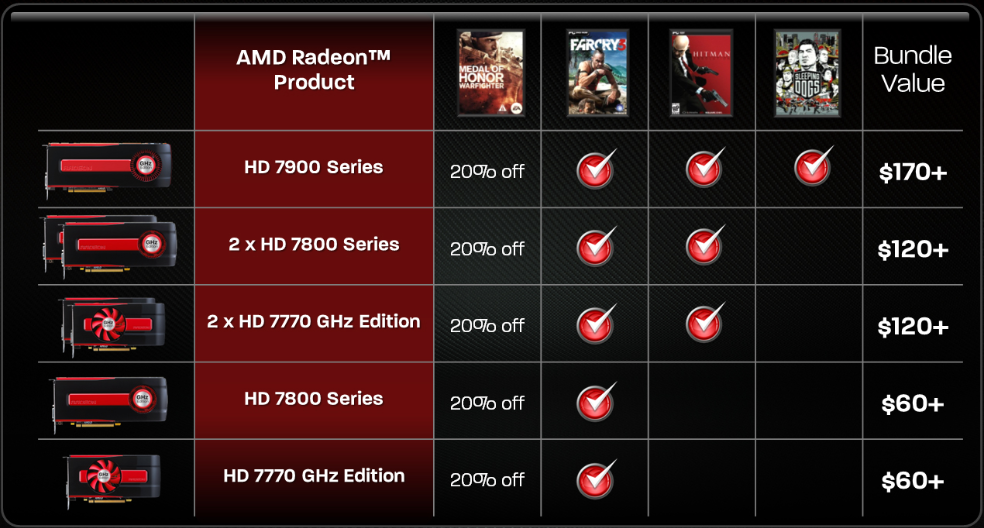
As part of the Never Settle Game Bundle, AMD is offering customers to three free games, plus get a coupon for 20 percent off Medal of Honor Warfighter with the purchase of select graphics cards. The best part? This is a direct from AMD promotion meaning it isn't tied to any specific GPU partner.

That means you can head over to Newegg or Amazon and buy one of the AMD card specified to qualify for the promotion. In addition to the 20 percent voucher, games up for grabs include Far Cry 3, Hitman Absolution, and Sleeping Dogs, all of which are free with the purchase of an AMD Radeon HD 7900 Series either the AMD Radeon HD 7970, AMD Radeon HD 7950 or the AMD Radeon HD 7970 GHz Edition Graphics Cards.


To obtain copies of the Games, each Participant must purchase an eligible AMD product (see "Eligible AMD Products") from a participating retailer and obtain from the participating retailer an AMD Unique ID. The AMD Unique ID is submitted on the www.amd.com/neversettlepromo site to obtain a Steam Game Key for Hitman: Absolution, a Steam Game Key for Sleeping Dogs, an UBIShop Game Key for FARCRY 3, and an EA Origin Discount Game Key for 20% off Medal of Honor Warfighter Deluxe Edition when purchased through EA Origin Store. Game Keys and Discount Game Keys are redeemed at www.steampowered.com/getsteam, http://shop.ubi.com/amdfarcry, and www.store.origin.com.

The promotion begins October 22, 2012 and ends on March 31, 2013. Medal of Honor Warfighter Digital Deluxe 20% discount expires December 31, 2012. Game Keys must be used to obtain Free Game downloads by April 30, 2013 and Discount Game Keys must be used to obtain discounted purchase of discount Game on or before December 31, 2012, after which the Game Keys and discount game keys are void, except that FARCRY 3 game keys are valid for a period of 1 year starting October 22, 2012 and will expire on October 22, 2013.

For more details on the promotion head over to the AMD Never Settle Page or visit this link for the full terms and conditions.

Tuesday, October 09, 2012

NVIDIA launches GeForce 650 Ti With $150 Assassins Creed 3 Bundle

NVIDIA has announced the new GeForce 650 Ti, a beefier version of the company's GTX 650 with extra Cuda cores and up to 40 percent more performance than the regular 650. That new card will fill the gap between the $229 GeForce GTX 660 and $109 GTX 650 cards and run $149 (estimated), with a free copy of Assassin Creed III.

The Assassin's Creed 3 bundle offering won't be offered with every version of the GTX 650 Ti, so you need to check that the card you're buying includes a download coupon for the game. A quick check on Newegg showed versions of the GTX 650 Ti from Asus, EVGA, Gigabyte, MSI, and Zotac all included the Assassin's Creed 3 bundle. Prices on Newegg started at $155.

GeForce GTX 650 Ti Specifications

Specifications GeForce GTX 660 Ti GeForce GTX 660 GeForce GTX 650 Ti GeForce GTX 650
ChipGK104GK106GK106GK107
CUDA Cores1344960768384
TMUs112806432
ROPs24241616
Base Clock915 MHz980 MHz925 MHz1058 MHz
Boost Clock980 MHz1033 MHzN/AN/A
Memory Configuration2 GB2 GB1 GB1 GB
Memory Speed6.0 Gbps6.0 Gbps5.4 Gbps5.0 Gbps
Memory Bandwidth144 GB/s144 GB/s86 GB/s80 GB/s
Power Connectors2 x 6-pin6-pin6-pin6-pin
Price$299 $229 $149 (estimated)$109

GeForce GTX 650 Ti Benchmarks and Reviews


Related articles:

Tuesday, May 17, 2011

NVIDIA Introduces New GeForce GTX 560 GPU

NVIDIA today introduced the new mainstream GeForce GTX 560 GPU, yes that is 560 and not the GeForce GTX 560 Ti which was released earlier this year. The new lower priced GTX 560 is the latest addition to the company's Fermi architecture-based product family and comes in priced at about $199 or $50 less than the GTX 560 Ti. Meaning the card is situated between the GeForce GTX 460 and GeForce GTX 560 Ti in terms of price and performance.


GeForce GTX 560 Specifications
  • 1024MB GDDR5 Memory
  • 810-950 MHz Graphics Clock
  • 1620-1900 MHz Processors Clock
  • 4008 MHz Memory Data Rate
  • 56 Texture Units
  • 336 Cuda Cores
  • 256-bit wide memory interface
  • 150w TDP
  • Support for Direct X 11, Open GL 4.1, 3D Vision, Cuda PhysX and 2 way SLI


GeForce GTX 560 Benchmarks and Reviews

For an in-depth look at the GTX 560, and to view a special video with footage from this summer's hottest PC games of the year, please visit: http://www.geforce.com/#/News/articles/560-game-previews/.


Related Articles

Friday, April 29, 2011

MSI N560GTX-Ti Hawk – How fast is it?

The following is a guest post by Andy G of http://www.bravofiles.com/ which features a great collection of hardware device drivers and software.


Introduction
MSI had great success with the R6870 Hawk powered by AMB and now with the launch of the card, which is fueled with an Nvidia GTX Ti GPU; they hope to fly even higher than before. It has the makings of being the best MSI has in regards to graphic solutions ever. Containing military class II components and MSI claims it will deliver the best performance and stability. Also containing MSI Afterburner functionality and Triple Over-voltage Support, which allows for intrinsic level of tweaking and completely beefed-up power delivery?

Speed
The N560GTX-Ti Hawk has 950mhZ on its GPU, 1900khZ on its shader and an effective 4,200mhZ for its memory of 1,024MB GDDR5. MSI is extremely confidant that with the cooling systems abilities, the card will be able to have clock speed in excess of 1GHz, without any problems. It contains the revolutionary new Twin Frozr III cooling system.

Features
It features the unique technology of Propeller blade, which is exclusive to MSI, which delivers airflow of up to twenty present more as oppose to conventional fans as well as reducing GPU temperatures with 17 degrees. Also featuring the PWM design is an 8+1, which effectively doubles power for the GPU. The graphics card, combined with the Triple Over-voltage technology greatly improves the potential over-clocking of the card. Over-clockers can use the Afterburner over-clocking utility, easily monitor the condition of their cards, and thus simplify over-clocking processes. It will allow the most demanding users to monitor Memory, GPU and PLL voltages at voltage measurement points with added multi-meters. Over-clockers should really invest in this latest innovation of MSI.

The Military Class II components include Tantalum capacitors with over eight times the lifetime as opposed to solid capacitors. Thirty present more powers are gained from the SFC choke and ten-year life service is guaranteed from the solid-cap capacitors. The choice to use these components is only to further the stability of the card and to ensure the highest quality as extreme over-clocking potential. MSI has their unique P/S switches, which allows consumers to change speed of dual fans in regards to their own usage environment and preference. Different performance modes will let the GPU temperature stay low even during high loads, which will enhance performance. The silent mode of the graphics card balances the fan noise using thermal management when used for multimedia or during games. The APS helps saving power by automatically controlling usage of PWM with the enhanced design.

Conclusion
Currently it will be the fastest as well as best GTX560 Ti graphics card available in the industry and sells at $272.00. Competitors will have to really dig deep to go better on this new innovation although the only complaint against it is the fact that it is only 1GB and consumers wish they could see it at 2GB. The installation of the card is made simple with a driver download of Nvidia graphics drivers where you will find products and drivers for MSI products and then follow online instructions to install.

Tuesday, April 19, 2011

AMD Releases New GPUs Fills Out The Radeon HD 6000 Series Line-up

AMD has rounded out the lower end of its Radeon HD 6xxx series video card lineup with the release of three new sub $100 cards the ultra-affordable Radeon HD 6450, the Radeon HD 6570 and Radeon HD 6670 which are priced at $59, $79 and $99 respectively.

According to AMD all three cards are designed to use minimal power; the 6450 has a TDP of 27 watts (and uses only 9 watts when idle) while the 6570 has a TDP of 44 watts (and uses only 10 watts when idle) and the 6670's TDP is 66 watts (and 12 watts while idling).

The cards pack the usual set of features you'd see from a low end card which include support for Microsoft's DirectX 11 (DX11); Eyefinity, for enhanced handling of multiple monitors. Both the 6450 and 6570 can drive up to 3 simultaneous displays(4 with with DisplayPort 1.2 Multi-Stream Transport), the 6670 supports up to 4 simultaneous displays (6 displays supported with DisplayPort 1.2 Multi-Stream Transport); AMD APP, which uses the GPU to accelerate other areas of processing performance; HD3D, for playing and watching stereoscopic 3D games and other content; and AMD CrossFireX multi-GPU technology.

The Radeon HD 6450 is definitely the low end featuring a 625-750 MHz engine clock, 160 stream processors, 8 texturing units and 16 Z/Stencil ROP Units units. The card can be configured with faster GDDR5 memory, AMD is now allowing for up to 1GB of GDDR5 video buffer to be installed that can be clocked between 800MHz and 900MHz.

The Radeon HD 6570 boasts a 650MHz engine clock, 480 stream processors, 24 texture units, 32 Z/Stencil ROP Units, and either 512MB-2GB of DDR3 clocked at 900MHz or 512MB-1GB of GDDR5 clocked at 1000MHz, both on a 128-bit memory bus.

The Radeon HD 6670 features many of the same specs, but comes clocked at 800MHz engine clock and includes 512MB-1GB of GDDR5 clocked at 1000MHz, also on a 128-bit interface.

Reviews:


Related Articles:

Tuesday, April 05, 2011

AMD Releases Mainstream Minded Radeon HD 6790

The GPU wars continue on as AMD has recently released the new $150 Radeon HD 6790 Video Card which at its current price point puts it in direct competition with Nvidia's recently released (and same-priced) GeForce GTX 550 Ti.


The new Radeon HD 6790 currently sits at the low end of AMD's 6000 series positioned somewhere above the HD 5770 and between the OEM only Radeon HD 6770 and the low-end-enthusiast Radeon HD 6850. Pricing and specifications on the card would indicate that AMD has intended the card to be used by gamers running mid-range resolutions of 1680x1050 with low to mid-range detail settings.

The card comes loaded with 1GB of GDDR5 ram has a core clock speed of 840 MHz, memory clock of 1050MHz (4.2GHz data rate), 800 stream processors, 40 texture units, and 16 ROPs and packs 1.34 teraflops of compute power with a Texture Filtering Rate of 33.6 GTex/s.

Most reviewers seem fairly impressed with the card but seem to agree that overall the price point it sits at isn't the best. The card only slightly outperforms the cheaper HD 5770 and is bested by the HD 6850 which can be had AMIR for around (or slightly above) the same price.

Radeon HD 6790 Benchmarks and Reviews

Related Articles

Sunday, March 27, 2011

AMD Challenging NVIDIA's World's Fastest GPU Claims

Laying out bold claims like "world's fastest" is nothing new and by now we should all be use to the marketing schemes that companies use to pry our money out of our hands. Savy consumers should know to wait for reviews, benchmarks and thorough testing before they jump on the band-wagon just because a company claims the top dog title.

This week, however, AMD has decided it wants to challenge the claims Nvidia is making about its latest graphics card, the GTX 590. When AMD launched the Radeon HD 6990, the company of course laid claims to the title of the fastest card on the market. The company even showed the card scored highest ever score using 3DMark 11 benchmark. Fast forward to a few days ago, when NVIDIA released the GTX 590, and NVIDIA is now claiming the fastest card title, but has not released any test scores to back that claim up.

Now AMD wants proof, and has challenged NVIDIA to prove its claim as to the title of fastest graphics card on the market. In a recent blog post Dave Erskine the Senior Public Relations Manager for Graphics Desktop at AMD threw out the challenge:


We combed through their announcement to understand how it was that such a claim could be made and why there was no substantiation based on industry-standard benchmarks, similar to what AMD did with industry benchmark 3DMark 11, the latest DirectX® 11 benchmark from FutureMark.  
So now I issue a challenge to our competitor: prove it, don’t just say it. Show us the substantiation. Because as it stands today, leading reviewers agree with us here, here, here, and here that the AMD Radeon HD 6990 sits on the top as the world’s fastest graphics card.


The gauntlet has been thrown down, it'll be interesting to see how (or if) NVIDIA responds. We know this is really just a war of the words between two rivals but I think its going to be fun to see how it plays out.

Thursday, March 24, 2011

NVIDIA Announces The New 'World's Fastest' Dual GPU GeForce GTX 590

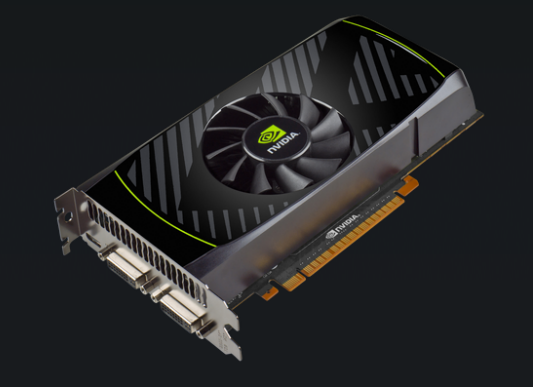
As teased yesterday by NVIDIA today the company announced the new NVIDIA GeForce GTX 590.


The new high end, meaning very expensive and extra powerful, GTX 590 is designed for the über enthusiasts and those looking to build the ultimate PC gaming rig. With dual NVIDIA Fermi class GPUs the card is taughted by NVIDIA as the "fastest dual graphics card available today."


With a combined 1024 NVIDIA CUDA architecture cores, 3GB of GDDR5 memory, 6 billion transistors and over 2200 individual components all packed into an 11 inch dual slot card, the GTX 590 delivers a staggering 32 tessellation engines that can power today's cutting edge DX11 games at resolutions of 2560x1600 and higher. The core is clocked at 607 MHz, the shaders are clocked at 1214 MHz, and the memory is clocked at 853 MHz for a memory data clock rate of 3414 MHz. This gives you a total effective memory bandwidth of 327.7 GB/s and a texture fill rate of 7.7 GigaTexels/s.

All that power means the GTX 590 is a bit of a power hungry beast, which should be expected. It has a Thermal Design Power (TDP) of 365 Watts pushing the recommended PSU rating to 700watts.

NVIDIA GeForce GTX 590 Benchmarks and Reviews

Related Articles

Newegg Pricing

Wednesday, March 16, 2011

Nvidia Releases Mainstream GeForce GTX 550 Ti

Earlier this week NVIDIA introduced the newest member of its Fermi based GPU family the GeForce GTX 550 Ti. A mainstream minded card with a $150 price tag and performance numbers to match.


The GeForce GTX 550 Ti is currently the bottom end of NVIDIA's 500 series lineup and is meant to be the successor to the GeForce GTS 450 which was released last fall, but will not directly replace it in the marketplace. (Nvidia claims the GTS 450 will be for sale until at least later this year.)

Both cards feature similar specs and build architecture. The GTX 550 Ti is an evolution of the previous-generation's GTS 450 - both cards utilize 40 nm chips with a 238mm die packed with 1.17 billion transistors. They both also feature a single graphics processing cluster that's made up of four 48-core streaming multiprocessors (SMs) giving them an identical 192 CUDA cores apiece, but that's roughly where the similarities end.

The GTS 450's GF106 die utilized only two of a possible three memory-controller partitions, resulting in a 256KB L2 cache, two sets of eight ROPs and a 128-bit memory interface. Thanks to improved yields and transistor-level changes, the GTX 550 Ti's revised GF116 die makes full use of all three memory-controller partitions - that means a larger 384KB L2 cache, a total of 24 ROPs and a 50 per cent wider 192-bit memory interface capable of delivering almost twice the memory bandwidth.

Core clock and memory clock speeds are bumped from 783/900 MHz in the GTS 450 to 900/1026 MHz in the GTX 550 Ti.Nvidia claims that all these changes, taken together, result in 28 percent performance increase over what that of the GTS 450, and thus 20 percent more performance per watt.

GeForce GTX 550 Ti Specifications

  • Core Clock 900MHz
  • Memory Clock 1026Mhz (4.104GHz data rate) GDDR5
  • Shader Clock 1800MHz
  • Memory Type 1024MB GDDR5
  • Memory Interface 192-bit
  • Stream Processors 192
  • Stream Processors Clock 1800MHz
  • Transistor Count 1.17B
  • Feature Support DirectX 11, OpenGL 4.1, NVIDIA 3d Vison, Cuda, PhysX, NVIDIA SLI

GeForce GTX 550 Ti Benchmarks and Reviews


Related Articles

NewEgg Pricing

Tuesday, March 08, 2011

AMD Releases The New $699 Radeon HD 6990

AMD has launched their new 'king of the hill' powerhouse gaming gpu the Radeon HD 6990, price tag $699. With the new HD 6990 AMD claims the title of 'world's fastest' graphics card!

Featuring a massive 4GB of GDDR5, 3,072 Stream Processors, 64 ROPs, and an 830MHz core clock speed. Add in a dual-BIOS switch setup to allow overclockers to tweak the card with automatic settings that allow you to crank that clock up to 880MHz with a corresponding increase in voltage. To push all that power the HD 6990 requires more power as the power-hungry card has a 375W TDP. In preliminary testing Anandtech reported the card sucked down over 490 watts of power during intense gaming benchmarks and as much as 550 watts when overclocked.

This thing is definitely a monster of a card!


Radeon HD 6990 Specifications

Full specs via AMD
  • Default (BIOS1)
    • Up to 830MHz Engine Clock
    • 5.10 TFLOPs Single Precision compute power
    • 1.27 TFLOPs Double Precision Compute Power
  • Overclocked (BIOS2)
    • Up to 880MHz Engine Clock
    • 5.40 TFLOPs Single Precision compute power o 1.37 TFLOPs Double Precision Compute Power
  • 4GB 2x2 GDDR5 Memory
  • 1250MHz Memory Clock (5.0 Gbps GDDR5)
  • 320 GB/s memory bandwidth (maximum) 
  • TeraScale 3 Unified Processing Architecture
    • 3072 Stream Processors
    • 192 Texture Units
    • 128 Z/Stencil ROP Units
    • 64 Color ROP Units
    • Dual geometry and dual rendering engines
  • High Speed 256-bit GDDR5 memory interface
  •  Second generation DirectX 11, OpenGL 4.1, Shader Model 5, DirectCompute 11 support


Radeon HD 6990 Benchmarks and Reviews


Related Articles

Wednesday, January 26, 2011

NVIDIA Introduces The New GeForce GTX 560 Ti

NVIDIA this week announced their newest 'mainstream' GPU the new $250 (MSRP) GeForce GTX 560 Ti.


The GeForce GTX 560 Ti is the newest addition of the Company's "Fermi" line of consumer level GPUs that were designed to deliver stunning DirectX 11 (DX11) performance for PC gaming platforms. According to NVIDIA, the GTX 560 Ti is up to 65% faster in the newest DX11 tessellation games and 30% faster in previous generation DX 9 and DX 10 games. The card features 1GB of DDR5 memory with an 822MHz graphics clock and a 1645MHz processor clock. There are eight tessellation engines, 384 CUDA cores giving the card a totally memory bandwidth of 128.3 GB/s a texture fill rate of 52.6 GigaTexels/sec.

Because this product is named similarly to the GTX 460 from the previous generation, consumers might think that this is a replacement to that line when in fact the GTX 560 Ti is more meant to be the perfect replacement for the now end-of-life GTX 470. The price to performance of the new card places it in the category not necessarily of the 'mainstream' but more of the upper midrange market segment. The new, and yet to be upcoming, GeForce GTS 550 will be more for the mainstream masses.


GeForce GTX 560 Ti Benchmarks and Reviews

Related Reading

NewEgg Pricing

Thursday, January 20, 2011

ATI Re-Branding Radeon HD 5700 Series To Radeon HD 6700 Series

Re-branding of GPUs is often a confusing situation for consumers. Many times shopped see a higher series number and think the are getting a better GPU when in fact in many cases they are getting the exact same model with a new flashier name. In some rare cases you might even be getting a worse GPU by looking at series models alone. That is why I always suggest you do your research and verify what you are buying.

This week ATI implemented the companies plans to re-brand the Radeon HD 5700 series to the a newly created HD 6700 series, by listing the Radeon HD 6770 and HD 6750 on its website. For now, the new cards are listed as available only to OEMs, however that won't stop consumers from being a little confused.

So to alleviate some of that confusion let me first say, as far as specifications go, there are no changes between the 5700 and 6700 series with the two exceptions of OpenGL 4.1 support and HDMI 1.4a support. Visually speaking you can see a different-looking cooler shroud on the reference-design graphics cards. Other than that, they're the same exact cards internally.

The HD 6770 is based on the 40 nm Juniper silicon, with 800 VLIW5 stream processors, and 1 GB of GDDR5 memory over a 128-bit wide memory interface. The HD 6750 on the other hand has 720 stream processors. There's no information at present on when (or if) AMD plans to release this to the consumer market.

If you really want to check for yourself here are the links that represent both incarnations of each card:

Tuesday, December 28, 2010

Unlock Your Radeon HD 6950 To An HD 6970 Via Firmware Unlock

It has been common practice over the years to release GPUs and CPUs built on the same design only with some of the features disabled in order to lower the cost. A few weeks ago AMD released the Radeon HD 6970 and Radeon HD 6950 both cards where based on the same reference design, same chips and same base configuration. The difference, the HD 6950 was clocked down to an 800mhz GPU clock and 1250mhz memory clock with only 1408 unified shaders versus the HD 6970 which features a 880 GPU clock, 1375 memory clock and 1536 unified shaders.

According to a recent post over at TechPowerUp, with few basic steps and a few pieces of software the new Radeon HD 6950 can be unlocked and transformed to a Radeon HD 6970 by unlocking 128 unified shaders and overclocking your HD 6950.

Full instructions along with links for all the software you'll need are available here. Unlocking the additional shaders is done by flashing the card with an HD 6970 BIOS. Overclocking can be achieved with any of your favorite GPU clocking applications.

There is no guarantee that your card will overclock to the higher speeds or that your card will handle the unlocking correctly. However with AMD's new dual bios option that allows for easy recovery should something go wrong you really can't miss.

Tuesday, December 14, 2010

AMD Radeon HD 6970 and HD 6950 Have Arrived

AMD today released the company's twp top dawgs the Radeon HD 6970 and Radeon HD 6950. The two new cards are meant to complete AMD’s Radeon HD 6000 single-GPU card family which was introduced back on October 21st. At that time, only the Radeon HD 6870 and Radeon HD 6850 were launched.

The Radeon HD 6970 and Radeon HD 6950 are completely identical in shape and size in fact they are essentially the same cards visually. Specifications aside the only major difference is that the 6970 requires one 8-pin and one 6-pin connector, while the 6950 requires two 6-pin connectors. Both cards support dual-link DVI and HDMI 1.4a natively. There is also support for a two miniDP outputs, version 1.2. Eyefinity is also fully supported.


A new feature added to the Radeon HD 6970 and Radeon HD 6950 is a dual-BIOS on board. AMD has implemented this dual-BIOS is so that people flashing their BIOS’s will not brick their video cards. One BIOS on video card contains the factory default which is protected. The other BIOS is open and allows you to flash to it. If you screw up your BIOS flash, all you have to do is switch the video card back (via an actual switch on the side of the card) to the protected BIOS and re-flash the other BIOS. Saving the user from bricking their pricey add-on.


Based on the early reviews the cards perform pretty much as expected with both the Radeon HD 6970 and HD 6950 showing very fine price-to-performance ratios. The 6970 manages to keep pace with the much pricier NVIDIA GTX 580, but is priced similarly to NVIDIA's GTX 570. The much cheaper HD 6950 seems to have hit the real value price point with a a great price-to-performance ratio making it the new bang-for-the-buck leader.

Radeon HD 6970 Specifications
The AMD Radeon HD 6970 packs 2.64 Billion transistors and 1,536 streaming processors running at 880MHz core clock speed on the 40nm process. There are 96 texture units, 32 ROPs and 128 Z-Stencil. There is 2GB of GDDR5 running at 5.5GHz on a 256-bit memory bus. This provides 176GB/sec of memory bandwidth.

Radeon HD 6950 Specifications
The Radeon HD 6950 is also based on the 40nm process with the same 2.64 Billion transistors. There are 1,408 streaming processors running at 800MHz core clock speed. There are 88 texture units, and the same 32 ROPs and 128 Z-Stencil count. There is also 2GB of 5GHz GDDR5 RAM being used which provides 160GB/sec of bandwidth.


Benchmarks and Reviews

Related Articles

Tuesday, December 07, 2010

NVIDIA Releases The New Nvidia GTX 570

NVIDIA today announced the release of their new GeForce GTX 570 -- the latest addition to the company's GTX 500 Series of DirectX 11 (DX11) GPUs. The GeForce GTX 570 is meant to bring a new level of DX11 price/performance to the enthusiast PC gaming market. The card is available today from most of NVIDIA's add-in card partners including ASL, ASUS, Colorful, ECS, EVGA, Gainward, Galaxy, Gigabyte, Innovision 3D, Jetway, Leadtek, MSI, Palit, Point of View, PNY, Sparkle, Zotac and others.


The GeForce GTX 570 features similar specifications to that of the GTX 480 but with a lower price at around $350. As the GeForce GTX 470 was to the GTX 480, the GTX 570 is essentially a cut down version of the recently released GTX 580. The GeForce GTX 570 boasts 480 CUDA cores, graphics clock speed of 732MHz, 4.5% higher than the GeForce GTX 480 and a shader frequency which was increased to 1464MHz.

The GeForce GTX 570 is paired with 1280MB of GDDR5 memory clocked at 950MHz (3800MHz DDR). Combine that with a memory interface of 320-bit and you get a peak theoretical bandwidth of 152GB/s.

Early benchmarks out the card pretty much in line with what we expect to see from a cut down GTX 580. The NVIDIA GeForce GTX 570 runs slightly slower the the GTX 580 but it stomps the GeForce GTX 470 and runs at the same performance level as the GeForce GTX 480 for much less money and at a cooler temp.

For a more details on the GeForce GTX 570 and additional product specifications, please visit this page.

Nvidia GTX 570 Benchmarks and Reviews

Related Articles

Tuesday, November 09, 2010

Nvidia GeForce GTX 580 Is Here!

NVIDIA has announced the new GeForce GTX 580 or what they are calling the "World's Fastest DX11 GPU". The GTX 580 runs at 772MHz, features 512 CUDA cores and packs 1.5GB of GDDR5 at 4008MHz, which is capable of delivering bandwidth of 192.4 GB/sec.

GeForce GTX 580 GPU Highlights:
  • 512 cores and 16 PolyMorph engines deliver massive tessellation and compute firepower for games
  • Hard launch with immediate availability at an estimated SEP of $499 USD.
  • Up to 35 percent improvement in performance/watt efficiency
  • New vapor chamber thermal solution results in the quietest GPU in its class
  • New level of geometric realism -- 2 billion triangles/second
  • Provides game developers total creative freedom to create cutting-edge DX11 games

GeForce GTX 580 Specifications:

  • 512 CUDA Cores
  • 772 MHz Graphics Clock
  • 1544 MHz Processor Clock
  • 49.4billion/sec Texture Fill Rate
  • 1536 MB GDDR5 Memory
  • 2004 MHz Memory Clock
  • 384-bit Memory Interface Width
  • 192.4GB/sec Memory Bandwidth
  • NVIDIA 3D Vision Ready, NVIDIA 3D Vision Surround Ready, NVIDIA PureVideo Technology HD, NVIDIA PhysX-ready, NVIDIA CUDA Technology
  • Microsoft DirectX 11 Support

The GeForce GTX 580 is available starting today from the world's leading add-in card partners, including ASL, ASUS, Colorful, ECS, EVGA, Gainward, Galaxy, Gigabyte, Innovision 3D, Jetway, Leadtek, MSI, Palit, Point of View, PNY, Sparkle, Zotac and others. The initial retail price is listed as $500 with several companies planning to add mail-in-rebate promotions soon.

GeForce GTX 580 Benchmarks and Reviews:


Related Reading:

Thursday, October 21, 2010

AMD Launches Radeon HD 6800 Series

AMD today introduced the companies next generation of PC gaming GPUs, the AMD Radeon HD 6800 series, designed to be the “perfect graphics cards” for gamers by delivering unprecedented game performance. The new AMD Radeon HD 6800 series graphics cards provide more than 30 percent greater game performance than competing products, harnessing AMD’s second-generation Microsoft DirectX 11-capable architecture, best-in-class energy efficiency, and an unmatched feature set, including AMD Eyefinity multi-display technology.

“AMD is the market share leader by a landslide in DirectX 11 graphics,” said Matt Skynner, corporate vice president and general manager, GPU Division, AMD. “Through our sweet spot strategy and our open, industry standards approach, we’ve worked to deliver the best possible experience for gamers. Today, our laser focus on gamers continues with the introduction of what we think is far and away the best graphics card series today, the AMD Radeon HD 6800 series. With exceptional game performance, an unrivaled feature set including breathtaking DirectX 11 gaming, AMD Eyefinity multi-display technology, AMD Accelerated Parallel Processing, and more, the AMD Radeon HD 6800 series will have all gamers wanting to get Radeon in their systems.”


The first two cards released under the 6800 series are the Radeon HD 6870 and Radeon HD 6850. Both cards are built with AMD's 40nm chips with a 255mm die size, 1.7B transistors and feature 1GB of GDDR5 with a 256-bit memory interface and 32 render back-ends. The two cards sport a dual-slot design and provide 2 mini-DisplayPort 1.2 connectors, 1 HDMI 1.4a connector, and 2 DVI ports with HD3D technology, AMD Eyefinity technology and AMD EyeSpeed visual acceleration support.


Pricing is set at an MSRP of $239 for the Radeon HD 6870 and $179 for the Radeon HD 6850.

AMD Radeon HD 6870 and 6850 Benchmarks and Reviews:


Related News:
Product page: AMD Radeon HD 6800 series product informationSource: AMD Press Release

Tuesday, October 12, 2010

NVIDIA GeForce GT 430 Introduced

nvidia logoNVIDIA this week introduced the latest addition to its Fermi class of graphics processing units (GPUs), the NVIDIA GeForce GT 430, which was specifically designed to provide the horsepower needed to power today's digital media PCs and provide the high definition video and audio experiences that desktop customers demand.

The GeForce GT 430 utilizes the Company's latest 40nm GPU, codenamed GF108, which is already designed into a variety of desktop and notebook platforms from the world's leading OEMs, including Acer, ASUS, Dell, HP, Lenovo, MSI, Samsung, Sony and others. For customers looking for a viable desktop upgrade from lowly integrated solutions, the GeForce GT 430 is a major step up, delivering unparalleled experiences in photo and video editing, Blu-ray 3D, as well as the next generation of GPU-accelerated Web browsers and Web content. And, when combined with NVIDIA 3D Vision™ technology and a compatible display, the GT430 is also the only GPU in its class that allows consumers to experience their digital content in full stereoscopic 3D.

nvidia geforce gt 430

Offering up to 1.5x the gaming performance of previous generation products, the GeForce GT 430 also adds support for DirectX 11 (DX11), the industry standard for game development. Most importantly, the GT 430 delivers unmatched out-of-the-box game compatibility(i) and playable frame rates in all of today's top 30 games(ii), when compared to integrated graphics solutions.
Key features of the new GeForce GT 430 include:

  • Support for HDMI 1.4a, a TV standard for delivering 3D content and advanced multi-channel digital audio
  • Special video engine to accelerate Blu-ray 3D content, delivering optimal 3D visuals at a full 1080p resolution
  • High-definition 24-bit multi-channel audio up to 192KHz, and lossless DTS-HD Master Audio and Dolby TrueHD audio bit streaming
  • Dedicated video processing engine for reduced system power and heat
  • Support for NVIDIA PhysX technology, the industry's most comprehensive, cross-platform physics solution 
GeForce GT 430 Specifications:

GPU Specs:
  • 96 Cuda Cores
  • Graphics Clock 700 MHz DDR3
  • Processor Clock 1400 MHz
  • Texture Fill Rate 11.2 (billion/sec)
Memory Specs:
  • Memory Clock 800 - 900 MHz DDR3
  • Standard Memory Config 1 GB DDR3/GDDR5 (2GB per GPU)
  • Memory Interface Width 128-bit
  • Memory Bandwidth 25.6 - 28.8 GB/sec
Feature Support:
  • NVIDIA 3D Vision Ready
  • NVIDIA PureVideo Technology HD
  • NVIDIA PhysX ready
  • NVIDIA CUD Technology
  • Microsoft DirectX 11
  • OpenGL 4.0
Display Support:
  • Maximum Digital Resolution 2560x1600
  • Maximum VGA Resolution 2048x1536
  • Standard Display Connectors HDMI
  • VGA (optional)
  • Dual Link DVI

    GeForce GT 430 Benchmarks and Reviews

    Related News:
    MSI launches N430GT-series graphics cards
    PNY Debuts GeForce GT 430 Graphics Card (PDF)
    SPARKLE Announced GeForce GT 430 Graphics Cards
    ZOTAC Unleashes GeForce GT 430 Series Graphics Cards
    GeForce your PC for the Ultimate Performance Upgrade with Inno3D GeForce GT430!
    GIGABYTE Launches Brand New Home Theater Solution NVIDIA GeForce GT 430 Graphics Card
    The EVGA GT 430 Has Arrived!


    Source: NVIDIA Press Release

    Tuesday, September 14, 2010

    NVIDIA Launches Budget Minded GTS 450

    NVIDIA this week announced the latest addition to the company's Fermi-class of GPUs, the NVIDIA GeForce GTS 450 -- which was designed to deliver the best DX11 price/performance in the $129 USD price category. According to the latest Steam survey, a leading indicator of the hardware used by PC gamers today, 56 percent(i) of gamers play at mainstream resolutions, typically between 1600x1050 and 1280x1024. The GTS 450 was specifically designed to excel at these resolutions, delivering awesome DX11 performance with 4X antialiasing turned on, enabling more gamers than ever before to experience incredibly detailed characters, terrain and game environments with blazing fast performance and awesome visuals.

    For games and applications that feature tessellation -- the key feature of DX11 -- the GTS 450 is up to 65% faster than the closest competitive product(ii). Even in last generation DX9 and DX10 games, the GTS 450 is faster by over 30%(iii), including in the blockbuster PC title StarCraft II. This makes the GTS 450 a terrific GPU for playing this year's hottest games including the upcoming holiday titles like Civilization V and Hawx2, both of which feature support for DX11 and tessellation, and other games, such as Dead Rising 2.

    "The GeForce GTS 450 makes huge strides in expanding DX11 capability to the masses," said Sid Meier, Director of Creative Development, Firaxis Games. "Civilization V plays beautifully on the GTS 450 and looks even more amazing with 3D Vision technology."

    "We are excited about the GeForce GTS 450, which brings awesome performance to a very affordable price point," said Shinsaku Ohara, Producer of Dead Rising 2 at Capcom. "By delivering a great gaming experience mixed with some cutting-edge features such as support for 3D Vision, we are confident that fans of Dead Rising 2 will have a great platform to play on."

    With full support for NVIDIA 3D Vision technology, the GeForce GTS 450 also provides the graphics horsepower and video bandwidth needed to experience games and high definition Blu-ray movies in eye-popping stereoscopic 3D. And with NVIDIA SLI technology, the industry's most scalable multi-GPU platform, gamers will be ecstatic to almost double their gaming performance by adding a second GTS 450 to their PC, when budget allows.

    The GeForce GTS 450 is available starting today from the world's leading add-in card partners, including ASL, ASUS, Colorful, ECS, EVGA, Gainward, Galaxy, Gigabyte, Innovision 3D, Jetway, KFA2, Leadtek, MSI, Palit, Point of View, PNY, Sparkle, Zotac and others. For more information, visit the product page.

    GTS 450 Benchmarks and Reviews:

    More Reading: